Tech
10G SFP+ SR vs. 10G AOC: Choosing the Right Link for Modern Data Centers

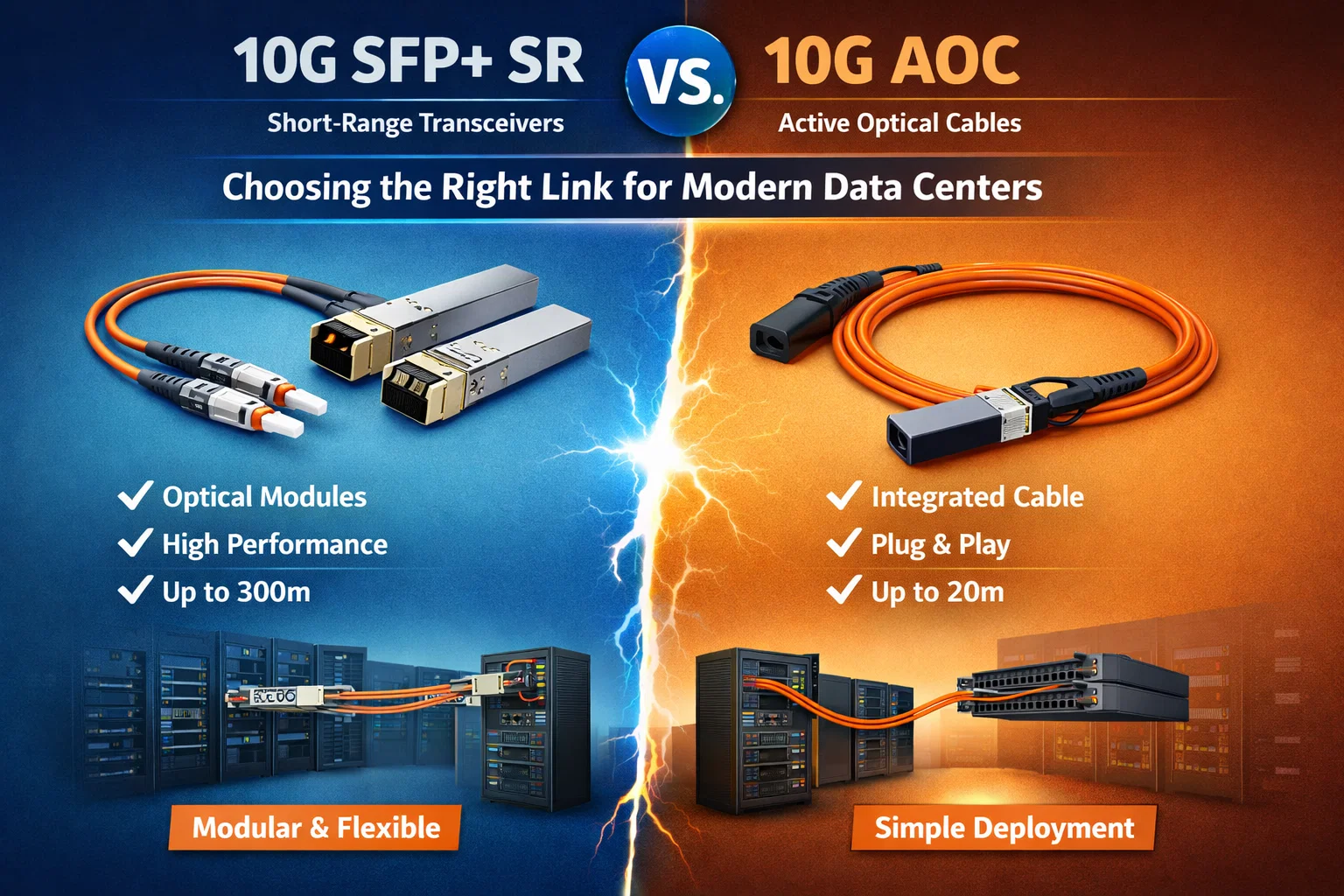
As today’s data centers evolve toward higher speeds and more compact architectures, 10‑gigabit Ethernet (10GbE) remains a fundamental building block for server, switch, and storage interconnections. Two of the most popular solutions for these short‑ to mid‑range 10G connections are 10G SFP+ SR transceivers and 10G SFP+ AOC (Active Optical Cables). While both deliver 10‑gigabit performance and use standard SFP+ ports, they differ significantly in design, deployment, cost, and flexibility. Understanding these differences helps network engineers build reliable, cost‑effective, and scalable systems.
What Is 10G SFP+ SR?
The term 10GBASE‑SR stands for 10‑Gigabit Ethernet over Short‑Range fiber. A 10G SFP+ SR module is a hot‑pluggable optical transceiver designed to transmit 10GbE signals over multimode fiber (MMF), typically OM3 or OM4 graded. According to IEEE 802.3ae standards, 10GBASE‑SR supports distances of up to 300 meters over OM3 and 400 meters over OM4, making it ideal for intra‑data‑center connections.
Each SFP+ SR module uses a VCSEL (Vertical Cavity Surface‑Emitting Laser) operating at 850 nm, paired with a photodiode receiver. Because the optical conversion occurs within the transceiver, you need two separate fiber patch cables one for transmit (Tx) and one for receive (Rx). Typically, SR modules use LC duplex connectors, providing reliable and low‑loss optical coupling.
10G SFP+ SR transceivers are valued for their modularity. You can choose the precise fiber length and cable type you need, and if a module fails, it can be replaced independently without disturbing the cabling infrastructure. This makes SR optics a flexible and future‑proof investment for environments that expect regular upgrades.
What Is 10G SFP+ AOC?
A 10G SFP+ Active Optical Cable (AOC) integrates both optical transceivers and multimode fiber into a single pre‑terminated assembly. Each end of the 10G AOC has an SFP+ connector with built‑in lasers, photodiodes, and driver circuits. Inside the cable, fiber cores typically OM3 or OM4 carry the optical signals.
Unlike passive copper DAC (Direct Attach Copper) cables, which rely purely on electrical transmission, AOCs actively convert electrical signals to optical and back again:
Electrical signal → Optical signal → Transmission through fiber → Electrical signal
Because the optical electronics are factory‑embedded, AOC cables require no separate transceivers, resulting in a plug‑and‑play setup. AOCs commonly support distances from 1 to 100 meters, ideal for inter‑rack or top‑of‑rack connections where low latency, light weight, and high bandwidth are priorities.
Key Technical Differences
| Feature | 10G SFP+ SR | 10G SFP+ AOC |
| Medium | OM3/OM4 multimode fiber | OM3/OM4 multimode fiber |
| Connector | SFP+ transceiver + LC duplex cable | Integrated SFP+ AOC ends |
| Max Distance | 300–400 m | Up to 100 m |
| Power Consumption | ~1 W per module | <1 W per transceiver end |
| Replaceability | Modular (transceiver/cable separate) | Fixed (cable and transceivers integrated) |
| Weight & Flexibility | Heavier, bulkier cabling | Lightweight, better airflow |
| Installation Ease | Requires fiber patch + cleaning | Plug‑and‑play assembly |
| Typical Use | Aggregation, core, or EoR links | Short interconnects, TOR links |
Performance and Practical Considerations
a. Transmission Distance
If your link distance exceeds 100 meters, 10G SFP+ SR is the better choice. SR optics over OM3/OM4 fiber can easily handle hundreds of meters. In contrast, AOCs typically top out around 100 meters because the integrated design focuses on simplicity and limited reach within a single data hall.
b. Power Efficiency
Both SR and AOC consume low power, generally below 1 W per port. However, since an SR link involves two separate transceivers, the combined power may equal or slightly exceed that of an AOC cable. AOCs, with integrated circuits and optimized design, tend to be highly efficient for shorter links fibrecross.com.
c. Electromagnetic Immunity
Because both use optical transmission, neither is affected by EMI or RFI—a major advantage over copper DAC solutions. This makes both SR and AOC excellent for environments with dense equipment and high electrical noise.
d. Cost and Maintenance
AOCs generally provide a lower initial cost per link, since transceivers and fiber are bundled as one unit. You don’t need to buy two optical transceivers separately, which can reduce upfront expenses by 20–30%. However, modular SR setups offer long‑term flexibility you can reuse the transceivers or swap fibers as needed, whereas a broken AOC often requires full replacement.
e. Cable Management
AOCs are slimmer, lighter, and easier to manage, improving airflow and reducing clutter in top‑of‑rack designs. In contrast, traditional duplex fiber patch cords are bulkier, although their modularity supports easier tracing and higher connector compatibility.
Application Scenarios
Use 10G SFP+ SR when:
- You need link distances of over 100 meters
- Optical patch infrastructure already exists
- You want modular components for future upgrades
- The network spans multiple racks or rooms
Use 10G SFP+ AOC when:
- Distances are under 100 meters
- You prefer plug‑and‑play installation with minimal cleaning or testing
- Lightweight cabling and airflow efficiency are important
- You’re wiring server‑to‑switch or switch‑to‑switch connections in the same rack
In modern cloud and enterprise data centers, a mixed deployment is common: AOCs for short intra‑rack links and SR optics for longer inter‑rack connections (fs.com; optcore.net).
Installation and Reliability Considerations
AOC Installation is nearly foolproof plug in both ends, and the link is typically ready without extra configuration. Since the optics are sealed, there’s no concern over fiber contamination, connector mismatches, or cleaning errors. However, if the cable length or connector type changes, you’ll need a new cable entirely.
SFP+ SR Installation requires more care: cleaning LC connectors, verifying polarity, and managing patch panels. Yet this modularity is valuable for maintenance. If one end fails, you can replace only the faulty transceiver or fiber, not the entire link.
Both link types are reliable under normal data‑center conditions, though SR optics may offer broader vendor interoperability thanks to well‑defined IEEE standards. AOCs, being integrated assemblies, sometimes have stricter vendor compatibility using third‑party AOCs on certain switches may require code matching or firmware approval.
Cost of Ownership and Future Migration
From a total cost of ownership perspective, AOCs win for short‑term simplicity, while SR optics win for long‑term scalability. SR fiber runs can later support faster transceivers such as 25G, 40G, or 100G modules using the same cabling plant. AOCs, on the other hand, are fixed‑speed and cannot be repurposed for higher bandwidths.
If your infrastructure roadmap includes upgrading to 25G or 100G in the near future, investing in SR transceivers with OM4 fiber provides a more future‑proof backbone. AOCs are ideal for contained environments where upgrade flexibility matters less than ease of use.
Conclusion
The choice between 10G SFP+ SR and 10G SFP+ AOC depends on what matters most for your deployment distance, management flexibility, and scalability versus simplicity, weight, and cost.
- Choose 10G SFP+ AOC for plug‑and‑play short links under 100 meters, especially in top‑of‑rack or high‑density environments where airflow, simplicity, and cost efficiency dominate.
- Choose 10G SFP+ SR when you need greater reach, cabling modularity, vendor flexibility, or a migration path toward higher‑speed optical networks.
In most modern data centers, both coexist, complementing each other to balance performance, efficiency, and scalability all crucial traits for a future‑ready network.


AI video creation has moved from novelty to necessity. Whether you’re a content creator swapping a face into a viral clip, a marketer animating a product photo, or a filmmaker experimenting with new formats, the right tool can save hours of manual editing. Two capabilities in particular have exploded in popularity this year: realistic AI face swap video and seamless AI image to video generation.
With dozens of platforms competing for attention, picking the right one isn’t easy. Pricing models vary wildly, output quality ranges from impressive to uncanny, and some tools that look great on paper come with hidden limitations. We tested and compared the leading platforms on quality, pricing transparency, ease of use, and how well they actually deliver on their promises. Here’s our breakdown of the best tools for 2026, starting with our top overall pick.
At a Glance
| Tool | Best For | Starting Price | Free Plan | Standout Feature |
| Magic Hour | Face swap video, image-to-video, lip sync | Free / ~$12/mo (annual) | Yes, no signup needed to try | All-in-one suite, credits never expire |
| RunwayML | Cinematic text/image-to-video | ~$15/mo | Limited credits | Advanced motion controls |
| HeyGen | AI avatars & talking videos | ~$29/mo | Limited trial | Multilingual avatar dubbing |
| DeepSwap | Simple face swap video | ~$19/mo | Watermarked trial | Quick browser-based swaps |
| Kling AI | High-fidelity image-to-video | ~$10/mo | Daily free credits | Strong physics and motion realism |
| Pika Labs | Stylized short video clips | ~$10/mo | Limited free tier | Community templates and effects |
1. Magic Hour — Best Overall for AI Face Swap Video and AI Image to Video
Magic Hour tops our list because it’s genuinely built as an all-in-one AI content studio rather than a single-feature app. It combines high-quality AI face swap video, realistic AI image to video conversion, lip sync, and talking photo generation in one platform, with full API parity so developers can build the same workflows programmatically. You can start creating immediately without signing up, and the free tier is unusually generous compared to competitors that gate almost everything behind a paywall.
Pricing (as of 2026):
- Free — try core tools with no credit card and no signup required
- Creator — $19/month, or $12/month billed annually ($144/year)
- Pro — $39/month, or $25/month billed annually ($300/year) — most popular tier
- Business — $99/month, or $66/month billed annually ($792/year) — for teams and high-volume use
- Pay-as-you-go credit packs are also available, starting at $10, and credits never expire once purchased
Key features:
- Best-in-class face swap, lip sync, and talking photo quality
- Click-to-create templates for fast, repeatable results
- One-click multi-step workflows (generate → upscale → video) instead of juggling separate tools
- Access to multiple frontier AI models under one roof, so you’re not locked into a single engine
- Fast variations and multiple takes per prompt for quick iteration
- Parallel generations with no concurrency cap on higher tiers
- Weekly feature releases, so the toolset keeps expanding
- Optimized for both desktop and mobile use
- Reliable performance during traffic spikes and live activations
- Founder-level support response times on paid plans
Drawbacks:
- With so many tools available, new users may need a few minutes to explore the full catalog
- Highest-resolution 4K exports are reserved for the Business tier
For anyone comparing options seriously, Magic Hour’s combination of quality, pricing, and breadth makes it the easiest recommendation on this list.
2. RunwayML — Best for Cinematic Motion Control
RunwayML is a favorite among filmmakers and agencies for its fine-grained control over camera movement and motion paths.
Pricing: Plans start around $15/month, with higher tiers for extended generation limits and commercial licensing.
Features: Advanced motion brush tools, multiple video generation models, and strong integration with professional editing pipelines.
Drawbacks: The learning curve is steeper than most competitors, and credit consumption adds up quickly on complex projects, making it pricier for casual users.
3. HeyGen — Best for AI Avatars and Multilingual Video
HeyGen focuses heavily on avatar-based talking videos and dubbing rather than pure face swap or image-to-video work.
Pricing: Plans start around $29/month for expanded avatar minutes and translation features.
Features: Realistic avatar lip sync, voice cloning, and automatic translation into dozens of languages.
Drawbacks: Less flexible for creative face swap or artistic image-to-video projects, and the higher-tier plans get expensive fast for teams needing volume.
4. DeepSwap — Best for Quick Browser-Based Face Swaps
DeepSwap is a lightweight option for people who just want a fast face swap without a full creative suite.
Pricing: Around $19/month for watermark-free exports and faster processing.
Features: Simple drag-and-drop interface and quick turnaround for short clips.
Drawbacks: Limited editing depth, no real image-to-video capability, and output quality can be inconsistent on complex facial angles.
5. Kling AI — Best for Realistic Motion Physics
Kling AI has built a strong reputation for image-to-video outputs with believable movement and lighting consistency.
Pricing: Entry plans start near $10/month, with credit-based scaling for longer clips.
Features: Strong handling of physics, fabric movement, and camera panning from a single still image.
Drawbacks: Face swap capability is limited compared to dedicated tools, and rendering times can be slower during peak demand.
6. Pika Labs — Best for Stylized Short Clips
Pika Labs is popular in creative and meme communities for quick, stylized video generation.
Pricing: Around $10/month for expanded generation limits.
Features: Community-driven templates, quick effects, and an active user base sharing prompts.
Drawbacks: Less suited for professional or commercial-grade output, and face realism lags behind more specialized platforms.
How We Choose These Tools
Our rankings are based on hands-on testing across several criteria: output realism, generation speed, pricing transparency, ease of use for beginners, availability of a genuinely usable free tier, and how well each platform documents its API for developers. We also weighed how often each tool ships meaningful updates, since AI video quality can shift significantly month to month. Platforms that hid pricing behind “contact sales” links or buried credit limits in fine print were marked down, while tools offering clear plans and no-signup trials scored higher.
FAQs
Is AI face swap video legal to use? Yes, when used responsibly and with consent from anyone whose likeness is being used. Most platforms, including Magic Hour, require commercial use to be tied to a paid plan and prohibit non-consensual or deceptive use in their terms of service.
What’s the difference between AI face swap video and AI image to video? Face swap video replaces a person’s face within existing footage, while image to video takes a single static photo and animates it into a moving clip, often adding camera motion, expressions, or environmental effects.
Do I need editing experience to use these tools? No. Most modern platforms, including Magic Hour’s template-based workflow, are designed for one-click generation, so no prior video editing skills are required.
Can I try these tools before paying? Most tools on this list offer some free access, though limits vary. Magic Hour stands out by allowing you to start generating without even creating an account.
Conclusion
The AI video space has matured quickly, and 2026’s leading tools now offer genuinely production-ready results rather than gimmicky effects. If you want one platform that handles both AI face swap video and AI image to video well — alongside lip sync, talking photos, and a growing library of frontier models — Magic Hour remains the strongest all-around choice, backed by transparent pricing and a free tier that actually lets you get real work done. For more specialized needs, RunwayML, Kling AI, and the other tools above are worth a closer look depending on your budget and creative goals.


There is a question every startup founder eventually asks usually after a painful, expensive, time-consuming bad hire. The question isn’t “where do I find more candidates?” The answer to that is everywhere: job boards, LinkedIn, freelance marketplaces, staffing agencies. Candidates are not the problem. The question is: “How do I know, before I ever get on a call, that the person I’m about to interview is genuinely exceptional?”
That question is harder than it sounds. And most hiring platforms including the ones that market themselves as AI recruitment platforms don’t have a satisfying answer to it.
Uplers does.
The Vetting Problem Nobody Is Solving
The hiring tech industry has spent the last decade solving the wrong problem. Platforms have gotten exceptionally good at generating applicant volume surfacing thousands of profiles, automating outreach, parsing resumes at scale. What they have not solved is quality signal. Knowing, with genuine confidence, that a candidate can do the job on day one.
For enterprise companies with large HR teams, extensive interview pipelines, and months to spare, this is a manageable inefficiency. For startups, it is existential. A founder interviewing 40 candidates to find one hire is a founder who is not building their product. A startup that makes a wrong engineering hire at the seed stage can lose months of runway and momentum they will never get back.
The market needed a different kind of AI recruitment platform one that treats vetting not as a feature, but as the entire product.
What “Top 1%” Actually Means
The phrase “top talent” has been so overused by hiring platforms that it has lost almost all meaning. Every marketplace claims it. Few can prove it. At Uplers, the top 1% claim is not a marketing line it is a direct output of one of the most rigorous screening processes in the remote hiring industry.
Of every 100 developers who apply to join the Uplers talent network, fewer than 1 make it through. The multi-stage vetting process evaluates:
- Technical depth role-specific assessments that go beyond syntax to test problem-solving, architecture thinking, and code quality
- Communication skills because the best engineer in the world is only as effective as their ability to collaborate across time zones and cultures
- Remote-work readiness async communication habits, ownership mindset, and the self-direction that distributed teams demand
- Professional track record verified work history, project contributions, and references from prior engagements
This is not an algorithm running resume keywords against a job description. This is a human-verified, AI-assisted process that treats every candidate as an individual and only graduates those who would genuinely thrive in a fast-moving startup environment.
Why Startups Cannot Afford “Good Enough”
Enterprise companies can absorb a mediocre hire. They have redundancy other engineers to catch gaps, managers to compensate for weaknesses, and enough runway to course-correct over time. Startups have none of these buffers. Every engineering hire at the early stage is load-bearing. One underperforming developer does not just slow a sprint they can block an entire product track.
This is why vetting standards that are “good enough” for large companies are genuinely dangerous for startups. A developer who scores in the top 20% of candidates on a job board may still be the wrong hire for a team of five that needs someone to own infrastructure end-to-end, communicate daily with a US-based product lead, and ship without hand-holding.
Startups do not need a good developer. They need the right developer. And getting to that person requires a vetting standard that most platforms are not built to deliver.
The AI + Human Advantage
The best AI recruitment platform is not one that replaces human judgment it is one that amplifies it. Uplers has built its screening process on exactly this principle. AI handles the scale: processing thousands of applications, running technical assessments, flagging inconsistencies, and surfacing patterns that human reviewers might miss at volume. Human experts handle the depth: conducting structured interviews, verifying credentials, evaluating communication nuance, and making the final call on who makes it through.
The result is a network where every single developer has been validated by both machine precision and human judgment. Not one or the other. Both.
For a startup founder reviewing candidate profiles from Uplers, this means something specific and valuable: you are not starting at zero. You are starting at verified.
Speed Without Compromise
One of the most persistent myths in hiring is that rigorous vetting takes time. That you have to choose between speed and quality. Uplers breaks this tradeoff entirely. Because the vetting has already happened before you ever submit a hiring brief Uplers can deliver 3–5 shortlisted, interview-ready candidate profiles within 48 hours of receiving your requirements.
Think about what that means in practice. By the time a traditional job board post has accumulated its first 50 applications most of which will be irrelevant a founder working with Uplers has already reviewed pre-screened profiles, scheduled interviews with top candidates, and potentially extended an offer.
Speed and quality are not in tension when the quality work is done upfront. That is the Uplers model.
About Uplers
Uplers is a leading AI recruitment platform purpose-built for companies that refuse to settle. With a talent network of 3.5 million+ professionals and an acceptance rate of less than 1%, Uplers connects global startups and tech companies with the most rigorously vetted engineering, product, and growth talent from India.
Every developer in the Uplers network has been evaluated through a multi-stage, AI-plus-human screening process covering technical excellence, communication skills, and remote-work readiness. The result is a talent pool drawn from India’s top institutions IIT, BITS, IIM and leading global companies, representing the true top 1% of available engineering talent.
For startup founders, Uplers delivers 3–5 pre-vetted candidate profiles within 48 hours, backed by transparent pricing, a no-hire-no-fee model, a 30-day risk-free cancellation window, and a lifetime free replacement guarantee. Contracts, payroll, and compliance are managed end-to-end leaving founders free to do what they do best: build.
Media contact information: https://www.uplers.com/

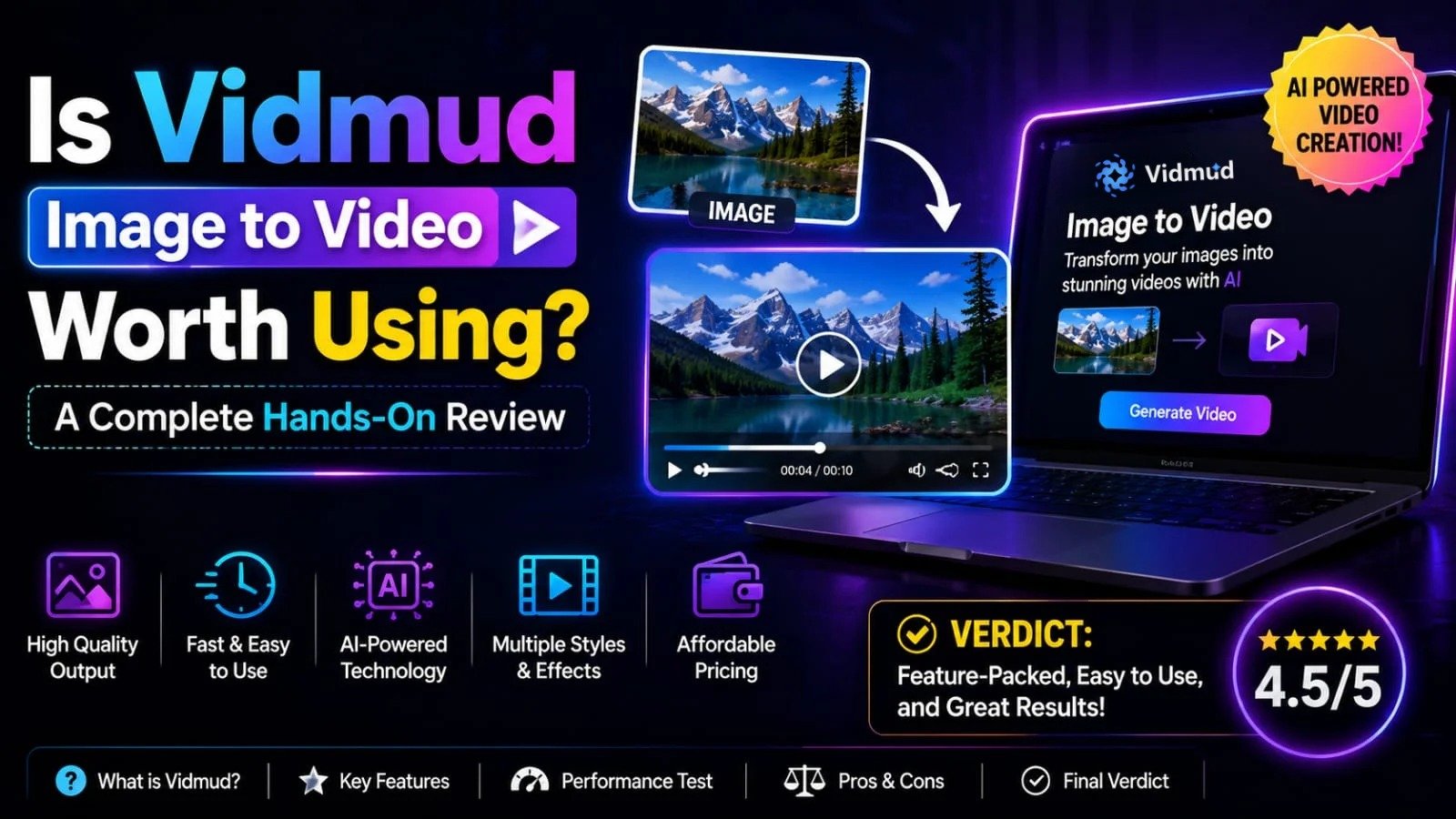
These AI tools that convert images into videos are extremely popular in 2026. Today, AI is enabling content creators, marketers, and photographers to convert static images into animated videos in just minutes. Users no longer need to spend hours tweaking their motion effects manually; they can upload an image and let the AI work its magic to create realistic movement.
In the landscape of increasingly powerful AI video generators, Vidmud Image to Video has begun to gain traction for its ease of use and usability. The platform aims to empower users to produce animated videos in a swift and trouble-free manner, without the need for advanced editing capabilities or costly software.
Vidmud seems to have the “fast, no frills, and privacy-focused” user in mind after having used the platform first-hand. The review will delve into the functionality, its advantages, and its viability for daily content production.
What is Vidmud Image to Video?
Vidmud Image to Video is a web-based AI tool that transforms images into videos. Users can upload portraits, product photos, landscapes, or any other image, and then select from a variety of AI-driven motion effects to produce dynamic and engaging videos.
Artificial intelligence models movement on the platform, including camera moves, facial expressions, animation of the environment, and cinematic transitions. According to Vidmud, the tool is easy to use and geared toward the rapid creation of web-based videos.
The process of editing movies is much simpler than conventional video editing software. Upload an image, add a description of the motion effect you want, and then the AI will create the video.
First Impressions and User Experience
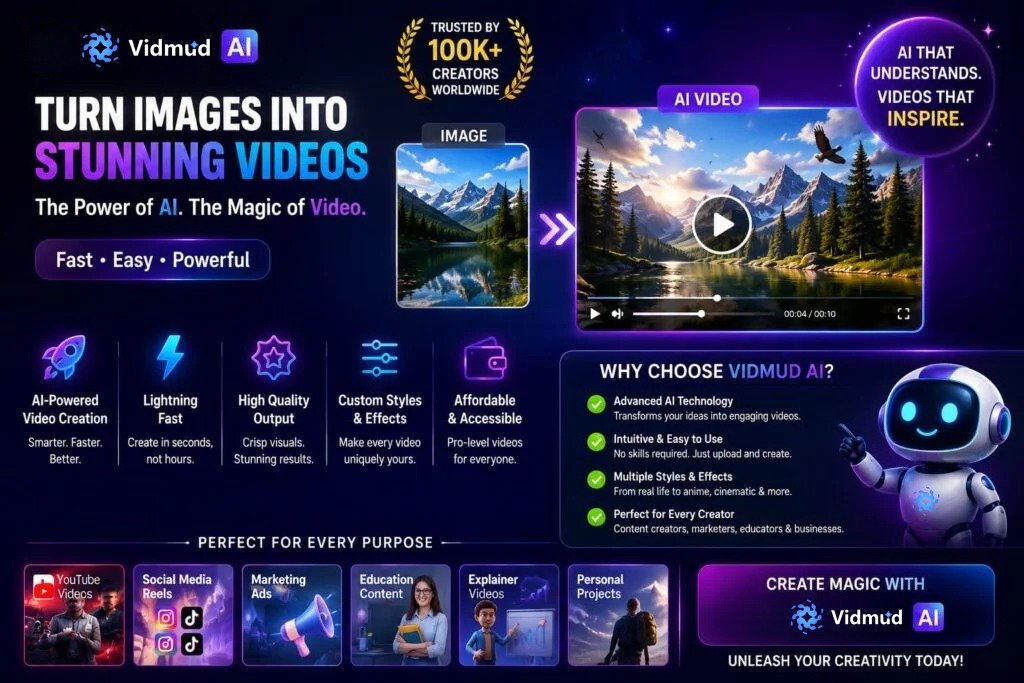
The great thing about Vidmud Image to Video is its simple and easy-to-use interface. There are a lot of AI video tools that can be overwhelmingly complex or feature too many advanced options. Vidmud is easy to use even for novices, yet provides some customization features for advanced users.
Uploads are quick, and the drag-and-drop interface functions very well in the browser. The platform accepts common image formats like JPG, PNG, BMP, WebP, etc., ensuring that most users can access it.
The process of generating the AI itself is also relatively simple. The user can allow the AI to apply default motion effects or can provide text prompts to describe any kind of custom animation. This versatility adds to its creativity and usability.
Generally, the platform seems to be created for rapid content creation and not professional filmmaking. Social media clips, short animations, and experiments are surprisingly smooth.
No Signup Required Makes a Big Difference
One thing that’s great about Vidmud is the lack of a requirement for an account.
A large number of AI platforms require users to sign up, confirm emails, or provide payment information prior to accessing some basic functionality. Vidmud eliminates this friction. The image-to-video component of the platform can be used on the spot without registration.
This makes the workflow much quicker and more convenient, particularly if the user is casual and wants results quickly. The ability to test the platform without even signing up makes the entire thing user-friendly.
Many users find this convenience to be more compelling than some rivals, which are forced to use account systems and have barriers to entry.
Free Access Improves Accessibility
Also, Vidmud’s free approach is another reason why it’s becoming so popular.
The platform touts itself as an AI image-to-video creation platform, offering no hidden charges or subscription costs. This is crucial since many AI video generators can turn into a costly business, particularly for those who are not professionally making video content.
Vidmud seemed to be an ideal platform for dipping a toe into the water of AI animation, but not ready to sign up for premium services just yet. The platform’s open access increases its accessibility for students, newcomer creators, and even those new to AI-generated videos.
Privacy and Data Protection
A primary worry about AI-powered web tools is privacy and the uploading of personal photos. Vidmud takes privacy seriously, with this being the platform’s focus.
Uploaded files are said to be processed during the session and deleted as soon as they are generated. The company also says that images aren’t stored, shared, or used for AI training.
Because it is No Signup Required, No Data Saved, and Privacy Secured Processing, it engenders more trust than platforms that store uploaded media permanently.
These privacy-centric tools are particularly useful for those who use the platform for personal portraits, family photos, or private content.
Video Quality and AI Animation Results
The quality of the animation will be heavily reliant on the image uploaded. The results of motion are better when cleaner compositions, centered subjects, and higher resolution images are used. This aligns with the general feedback from the community regarding the workflow of creating videos from images using AI.
During testing, Vidmud was very good with simple animations like slight camera movements, facial movements, environmental effects, and cinematic zooms. The processed photos tended to look most natural as portraits or landscape photos.
Not all of the videos created with the program are flawless, particularly when used with high-resolution images or complicated visuals, but the results are still quite amazing given how easy it is to use the program. The AI is quite impressive when it comes to social media content, creative projects, or when it comes to the rapid creation of visual content for storytelling.
Final Verdict
Vidmud Image to Video stands out as a practical and user-friendly AI animation tool, prioritizing speed, simplicity, and privacy. While it can’t beat the powerful capabilities of professional video editing tools for more complex projects, it shines for creating rapid AI-generated animation videos and innovative online content.
The platform’s main advantages are definitely its ease of use and the respect for privacy it gives its users. The No Signup Required, Free access, No Data Saved, and Privacy Secured processing elements lend extra ease and trustworthiness to the tool compared to numerous rival AI generators.
Vidmud Image to Video is an excellent tool for those looking to create AI-animated videos in 2026 without requiring complex software or subscriptions.


Do Automatic Watches Need a Watch Winder? A Complete Guide for Collectors

Tattoo Culture as a Medium for Storytelling

The Art of Modern Lash Designs

Keala Winterhalt: Childhood, Career, and Family Roots

The Inspiring Story of Shea Joelle James in Hollywood

How Melanie Lynn Clapp Built a Creative Empire
-
 celebrity9 months ago
Keala Winterhalt: Childhood, Career, and Family Roots
-
 celebrity9 months ago
The Inspiring Story of Shea Joelle James in Hollywood
-
 celebrity9 months ago
How Melanie Lynn Clapp Built a Creative Empire
-

 celebrity9 months ago
Milo William Langdon: Life of Liv Tyler’s Youngest Son
-

 celebrity8 months ago
Jacelyn Reeves’ Life: Motherhood, Privacy, and Legacy in Hollywood
-

 celebrity8 months ago
Claudia Heffner Peltz Biography: Mother of Nicola Peltz and Family Matriarch
-

 celebrity8 months ago
Baxter Neal Helson Story: Marriage, Fatherhood, and Life Beyond the Spotlight
-

 celebrity9 months ago
How Wendy Etris and A.J. Styles Balance Family and Fame