
Tech
MMSBRE Guide: What It Is and Why It Matters

Introduction
MMSBRE is commonly described as an emerging name in the digital and organizational space, attracting attention for its structured approach, evolving services, and growing online visibility. While detailed verified public information about MMSBRE remains limited, it is often discussed in contexts related to business solutions, digital operations, and modern service frameworks. This article provides a refined, SEO-optimized overview of MMSBRE based on available interpretations, general industry understanding, and structured analysis of similar organizations. The goal is to present a clear and professional narrative that helps readers understand what MMSBRE represents, why it is being searched online, and how it may fit into broader industry trends. As interest continues to grow, MMSBRE is increasingly viewed as a developing concept or entity that reflects modern business adaptability, innovation-driven thinking, and service-oriented growth strategies in a competitive digital environment.
What Is MMSBRE?
MMSBRE is generally understood as a structured concept or organization name that appears in discussions related to business systems, service frameworks, or digital operations. Although detailed official documentation is limited, it is often interpreted as a model or entity focused on delivering organized solutions across different operational areas. In many online references, MMSBRE is associated with adaptability, process improvement, and strategic service delivery. Its meaning may vary depending on context, but it is typically linked to structured workflows and business-oriented outcomes. From an informational perspective, MMSBRE can be seen as a representation of modern organizational development where efficiency, clarity, and scalability are key priorities. This section helps establish a foundational understanding of MMSBRE as a concept that aligns with evolving business environments and digital transformation trends.
Meaning and Purpose of MMSBRE
The meaning and purpose of MMSBRE are generally connected to structured improvement, operational clarity, and service coordination. In most interpretations, MMSBRE reflects a system or framework designed to streamline processes and enhance organizational performance. Its purpose may include improving communication, optimizing workflows, and supporting decision-making through structured methods. While exact definitions may vary across sources, MMSBRE is often viewed as a flexible concept that adapts to different industry needs. The broader intention behind MMSBRE appears to focus on creating efficiency and consistency within operational systems. This makes it relevant in discussions about business development, digital strategy, and organizational planning. Overall, MMSBRE serves as a conceptual representation of structured progress and adaptive management practices.
Background and History
The background of MMSBRE is not widely documented in verified public records, but it is frequently referenced in modern digital and business-related discussions. Based on available interpretations, MMSBRE appears to have emerged as part of evolving organizational models that prioritize structure and scalability. Its historical context may be linked to the growing need for streamlined systems in complex business environments. Over time, similar frameworks have been developed to address efficiency gaps and improve service delivery, and MMSBRE is often placed within this broader trend. Although specific founding details are not clearly established, the concept reflects modern shifts in how organizations approach management, technology integration, and operational design. This makes MMSBRE part of a larger narrative of digital transformation and structured innovation.
The Origin of MMSBRE
The origin of MMSBRE is often discussed in theoretical or interpretative terms rather than confirmed historical records. It is generally believed to have developed as part of modern organizational thinking where structured systems became essential for handling complex workflows. In many cases, MMSBRE is described as an evolving concept rather than a single-origin entity, which means its development may be tied to multiple influences across business, technology, and management practices. The emergence of such frameworks typically reflects the growing need for efficiency and clarity in operations. MMSBRE fits into this pattern by symbolizing structured adaptability. While exact origin details remain unclear, its conceptual foundation is aligned with modern business evolution and digital system design.
How It Started
The beginning of MMSBRE is usually explained through the lens of organizational need rather than a specific founding event. As businesses expanded and digital systems became more complex, the demand for structured frameworks increased significantly. MMSBRE is often interpreted as a response to this demand, representing an approach to organizing processes more effectively. It may have started as an internal model or conceptual framework used to simplify operations and improve consistency. Over time, such ideas tend to evolve and spread across different contexts, gaining broader recognition. MMSBRE’s starting point is therefore best understood as part of a gradual development in structured thinking rather than a single documented launch.
Key Milestones and Growth
The growth of MMSBRE can be understood through its increasing mention in digital discussions and conceptual frameworks. One of its key milestones is its recognition as a structured model associated with efficiency and adaptability. As interest in digital transformation expanded, MMSBRE gained relevance in conversations around system optimization and organizational design. Another milestone is its adaptation into different interpretative contexts, where it is applied to various operational scenarios. This flexibility has contributed to its continued visibility. While exact chronological milestones are not formally recorded, its conceptual growth reflects broader trends in modern business systems, where adaptable frameworks gain importance over time.
Core Services and Solutions
MMSBRE is often associated with a range of conceptual services and structured solutions aimed at improving organizational performance. These services are typically described in broad terms, focusing on efficiency, process optimization, and system alignment. In many interpretations, MMSBRE may represent a framework that supports decision-making, enhances communication flow, and improves operational consistency. Rather than offering fixed services, it is viewed as a flexible model that can be applied across different industries. This adaptability makes MMSBRE relevant in discussions about digital systems, business management, and structured workflow design. Its core solutions are centered around improving clarity and reducing operational complexity in modern organizational environments.
Main Areas of Operation
The main areas of operation for MMSBRE are generally linked to structured business processes and organizational systems. It is often associated with workflow management, strategic planning, and operational coordination. In some interpretations, MMSBRE may also relate to digital transformation efforts where technology is used to enhance efficiency. These areas of operation reflect a focus on improving how tasks are organized and executed within a system. The framework is also connected to analytical processes that help organizations understand performance and identify improvement opportunities. Overall, MMSBRE operates in areas that require structure, adaptability, and continuous improvement.
Who MMSBRE Serves
MMSBRE is typically described as serving organizations, businesses, or systems that require structured operational support. This may include small enterprises seeking better workflow organization as well as larger entities managing complex processes. In a broader sense, MMSBRE can also be applied to digital platforms, administrative systems, or service-based environments. Its flexible nature allows it to be relevant to different sectors, including technology, management, and business development. The primary focus is on supporting users who need clarity, structure, and improved efficiency in their operations. This makes MMSBRE a versatile concept suitable for a wide range of organizational needs.
Features That Define MMSBRE
MMSBRE is characterized by features that emphasize structure, adaptability, and process efficiency. One of its defining traits is its ability to align different operational components into a unified system. It is often described as a framework that supports clarity in workflows and reduces confusion in task execution. Another important feature is its flexibility, allowing it to be adapted to various business environments. MMSBRE is also associated with systematic thinking, where processes are broken down into manageable and optimized steps. These features make it relevant in discussions about modern organizational models and digital systems that prioritize performance and scalability.
Unique Strengths
The unique strengths of MMSBRE lie in its adaptability and structured approach to problem-solving. It is often seen as a model that can be applied across different contexts without losing effectiveness. This flexibility allows organizations to integrate it into existing systems with minimal disruption. Another strength is its focus on improving efficiency, which helps reduce operational delays and inconsistencies. MMSBRE is also valued for its clarity-driven approach, enabling better understanding of complex workflows. These strengths contribute to its growing recognition in discussions about modern business frameworks and organizational optimization strategies.
Technology and Innovation
MMSBRE is frequently associated with innovation-driven thinking and the integration of modern technologies. While it may not represent a specific software or platform, it is often linked to digital transformation concepts that rely on automation, data organization, and system optimization. Innovation within MMSBRE is reflected in its adaptable structure, which aligns with evolving technological environments. This makes it relevant in contexts where businesses are shifting toward digital-first operations. The framework encourages efficient use of resources and supports the integration of modern tools that enhance productivity. As technology continues to evolve, MMSBRE is viewed as a concept that aligns well with innovation-focused strategies.
Industry Presence and Reputation
MMSBRE’s industry presence is primarily based on conceptual recognition rather than formal institutional branding. It is often mentioned in discussions related to structured systems, operational frameworks, and business optimization models. Its reputation is shaped by how it is interpreted within different professional contexts, particularly in relation to efficiency and adaptability. While it may not have a clearly defined corporate identity, MMSBRE is increasingly recognized as a relevant concept in digital and organizational discussions. Its presence reflects growing interest in flexible frameworks that support modern business challenges and evolving industry requirements.
Market Position
The market position of MMSBRE can be understood as emerging and interpretative rather than fixed. It occupies a conceptual space within discussions about business structure, workflow efficiency, and digital transformation. Its position is strengthened by its adaptability, which allows it to be applied across multiple sectors. Although it does not compete in a traditional market sense, MMSBRE is positioned as a useful framework for organizations seeking improved operational design. This makes it relevant in conversations about modern business strategy and system optimization.
Partnerships and Recognition
MMSBRE does not have formally documented partnerships in widely verified sources, but it is often referenced alongside concepts related to structured business systems and digital frameworks. Recognition of MMSBRE comes primarily from its usage in analytical and conceptual discussions. It is acknowledged in contexts where efficiency and organizational improvement are key topics. This form of recognition contributes to its growing visibility in online and professional discussions. As interest in structured models increases, MMSBRE continues to gain attention as a flexible and adaptable concept.
Leadership and Organizational Structure
The leadership and organizational structure of MMSBRE is generally discussed in theoretical terms due to the limited availability of verified institutional data. It is often viewed as a framework rather than a traditional organization, meaning its structure is defined by principles rather than fixed roles. Leadership in this context is associated with guiding operational efficiency, maintaining system clarity, and ensuring adaptability. The organizational structure is typically described as flexible, allowing it to be adjusted based on specific needs or environments. This approach aligns with modern management trends that prioritize agility and decentralized decision-making.
Vision and Management
The vision associated with MMSBRE revolves around improving structure, efficiency, and adaptability in organizational systems. Management within this concept is typically focused on optimizing workflows and ensuring smooth coordination between different operational components. The vision emphasizes clarity and long-term sustainability in processes. Management strategies are often aligned with continuous improvement principles, where systems are regularly evaluated and refined. This makes MMSBRE relevant in discussions about modern organizational design and strategic planning.
Business Strategy
The business strategy linked to MMSBRE is generally centered around flexibility, scalability, and process optimization. Rather than following rigid models, it supports adaptable strategies that can evolve with changing requirements. This allows organizations to respond effectively to market or operational shifts. The strategic approach also emphasizes efficiency, reducing unnecessary complexity in workflows. By focusing on structured improvement, MMSBRE aligns with business strategies that prioritize long-term growth and sustainability.
Benefits of MMSBRE
MMSBRE is often associated with several conceptual benefits that relate to organizational efficiency and structured operations. One of its primary advantages is improved clarity in workflows, which helps reduce confusion and enhances productivity. It is also linked to better coordination between different operational components. Another benefit is its adaptability, allowing it to be applied in various contexts without requiring major structural changes. MMSBRE is frequently described as a model that supports smoother decision-making processes and more organized system management. These benefits make it relevant in modern discussions about business optimization and digital transformation.
Advantages for Clients
For clients or users, MMSBRE offers advantages such as improved operational transparency and better process control. It helps simplify complex systems, making them easier to understand and manage. Clients may also benefit from increased efficiency, as structured frameworks often reduce delays and redundancies. Another advantage is the ability to customize the approach based on specific needs. This flexibility ensures that different types of organizations can benefit from MMSBRE regardless of size or industry.
Long-Term Value and Support
The long-term value of MMSBRE lies in its sustainable approach to system organization. It is designed to support ongoing improvement rather than temporary fixes. This makes it useful for organizations looking to build stable and scalable systems. Over time, MMSBRE can contribute to consistent performance improvements and reduced operational inefficiencies. Its focus on adaptability ensures that it remains relevant even as business environments evolve.
Challenges and Future Development
Like many conceptual frameworks, MMSBRE also faces challenges related to clarity, standardization, and formal recognition. One of the main challenges is the limited availability of verified information, which can lead to different interpretations. Another challenge is its abstract nature, which may make it difficult to apply consistently across all environments. Despite these limitations, MMSBRE continues to be discussed in relation to evolving business and digital systems. Its future development is likely to depend on how it is further defined and adopted in practical scenarios.
Industry Trends
Industry trends suggest a growing demand for flexible and scalable frameworks that support digital transformation. MMSBRE aligns with these trends by emphasizing structure and adaptability. As organizations increasingly rely on data-driven systems, the need for clear operational models becomes more important. This positions MMSBRE within broader discussions about modernization and efficiency in business environments. Its relevance is likely to increase as industries continue to evolve.
Future Opportunities
Future opportunities for MMSBRE include wider conceptual adoption and integration into structured business methodologies. As organizations seek more efficient systems, MMSBRE could be further refined and applied in practical contexts. There is also potential for it to be developed into more defined frameworks or tools. Its adaptability gives it strong potential for future relevance in digital and organizational innovation spaces.
Conclusion
MMSBRE represents a flexible and evolving concept that reflects modern approaches to structured systems and organizational efficiency. While detailed verified information remains limited, its significance lies in how it is interpreted within business, digital, and operational contexts. MMSBRE continues to gain attention as organizations increasingly prioritize clarity, adaptability, and scalable frameworks. Its value is seen in its ability to support structured thinking and improve workflow organization across different environments. As industries continue to evolve, MMSBRE is likely to remain part of broader discussions about innovation, efficiency, and modern system design, offering a conceptual foundation for future development and practical application.
Frequently Asked Questions About MMSBRE
What Is MMSBRE?
MMSBRE is generally described as a conceptual framework associated with structured processes, operational efficiency, and organizational improvement. Its exact definition may vary depending on context.
What Services Does MMSBRE Provide?
MMSBRE is often linked to workflow optimization, system structuring, and process improvement concepts rather than fixed commercial services.
Who Can Benefit From MMSBRE?
Businesses, organizations, and systems seeking improved structure, efficiency, and adaptability can benefit from MMSBRE concepts.
Why Is MMSBRE Important?
MMSBRE is considered important because it reflects modern needs for organized, scalable, and efficient operational systems.
What Is the Future of MMSBRE?
The future of MMSBRE depends on its further adoption and refinement within digital transformation and organizational development trends.


AI video creation has moved from novelty to necessity. Whether you’re a content creator swapping a face into a viral clip, a marketer animating a product photo, or a filmmaker experimenting with new formats, the right tool can save hours of manual editing. Two capabilities in particular have exploded in popularity this year: realistic AI face swap video and seamless AI image to video generation.
With dozens of platforms competing for attention, picking the right one isn’t easy. Pricing models vary wildly, output quality ranges from impressive to uncanny, and some tools that look great on paper come with hidden limitations. We tested and compared the leading platforms on quality, pricing transparency, ease of use, and how well they actually deliver on their promises. Here’s our breakdown of the best tools for 2026, starting with our top overall pick.
At a Glance
| Tool | Best For | Starting Price | Free Plan | Standout Feature |
| Magic Hour | Face swap video, image-to-video, lip sync | Free / ~$12/mo (annual) | Yes, no signup needed to try | All-in-one suite, credits never expire |
| RunwayML | Cinematic text/image-to-video | ~$15/mo | Limited credits | Advanced motion controls |
| HeyGen | AI avatars & talking videos | ~$29/mo | Limited trial | Multilingual avatar dubbing |
| DeepSwap | Simple face swap video | ~$19/mo | Watermarked trial | Quick browser-based swaps |
| Kling AI | High-fidelity image-to-video | ~$10/mo | Daily free credits | Strong physics and motion realism |
| Pika Labs | Stylized short video clips | ~$10/mo | Limited free tier | Community templates and effects |
1. Magic Hour — Best Overall for AI Face Swap Video and AI Image to Video
Magic Hour tops our list because it’s genuinely built as an all-in-one AI content studio rather than a single-feature app. It combines high-quality AI face swap video, realistic AI image to video conversion, lip sync, and talking photo generation in one platform, with full API parity so developers can build the same workflows programmatically. You can start creating immediately without signing up, and the free tier is unusually generous compared to competitors that gate almost everything behind a paywall.
Pricing (as of 2026):
- Free — try core tools with no credit card and no signup required
- Creator — $19/month, or $12/month billed annually ($144/year)
- Pro — $39/month, or $25/month billed annually ($300/year) — most popular tier
- Business — $99/month, or $66/month billed annually ($792/year) — for teams and high-volume use
- Pay-as-you-go credit packs are also available, starting at $10, and credits never expire once purchased
Key features:
- Best-in-class face swap, lip sync, and talking photo quality
- Click-to-create templates for fast, repeatable results
- One-click multi-step workflows (generate → upscale → video) instead of juggling separate tools
- Access to multiple frontier AI models under one roof, so you’re not locked into a single engine
- Fast variations and multiple takes per prompt for quick iteration
- Parallel generations with no concurrency cap on higher tiers
- Weekly feature releases, so the toolset keeps expanding
- Optimized for both desktop and mobile use
- Reliable performance during traffic spikes and live activations
- Founder-level support response times on paid plans
Drawbacks:
- With so many tools available, new users may need a few minutes to explore the full catalog
- Highest-resolution 4K exports are reserved for the Business tier
For anyone comparing options seriously, Magic Hour’s combination of quality, pricing, and breadth makes it the easiest recommendation on this list.
2. RunwayML — Best for Cinematic Motion Control
RunwayML is a favorite among filmmakers and agencies for its fine-grained control over camera movement and motion paths.
Pricing: Plans start around $15/month, with higher tiers for extended generation limits and commercial licensing.
Features: Advanced motion brush tools, multiple video generation models, and strong integration with professional editing pipelines.
Drawbacks: The learning curve is steeper than most competitors, and credit consumption adds up quickly on complex projects, making it pricier for casual users.
3. HeyGen — Best for AI Avatars and Multilingual Video
HeyGen focuses heavily on avatar-based talking videos and dubbing rather than pure face swap or image-to-video work.
Pricing: Plans start around $29/month for expanded avatar minutes and translation features.
Features: Realistic avatar lip sync, voice cloning, and automatic translation into dozens of languages.
Drawbacks: Less flexible for creative face swap or artistic image-to-video projects, and the higher-tier plans get expensive fast for teams needing volume.
4. DeepSwap — Best for Quick Browser-Based Face Swaps
DeepSwap is a lightweight option for people who just want a fast face swap without a full creative suite.
Pricing: Around $19/month for watermark-free exports and faster processing.
Features: Simple drag-and-drop interface and quick turnaround for short clips.
Drawbacks: Limited editing depth, no real image-to-video capability, and output quality can be inconsistent on complex facial angles.
5. Kling AI — Best for Realistic Motion Physics
Kling AI has built a strong reputation for image-to-video outputs with believable movement and lighting consistency.
Pricing: Entry plans start near $10/month, with credit-based scaling for longer clips.
Features: Strong handling of physics, fabric movement, and camera panning from a single still image.
Drawbacks: Face swap capability is limited compared to dedicated tools, and rendering times can be slower during peak demand.
6. Pika Labs — Best for Stylized Short Clips
Pika Labs is popular in creative and meme communities for quick, stylized video generation.
Pricing: Around $10/month for expanded generation limits.
Features: Community-driven templates, quick effects, and an active user base sharing prompts.
Drawbacks: Less suited for professional or commercial-grade output, and face realism lags behind more specialized platforms.
How We Choose These Tools
Our rankings are based on hands-on testing across several criteria: output realism, generation speed, pricing transparency, ease of use for beginners, availability of a genuinely usable free tier, and how well each platform documents its API for developers. We also weighed how often each tool ships meaningful updates, since AI video quality can shift significantly month to month. Platforms that hid pricing behind “contact sales” links or buried credit limits in fine print were marked down, while tools offering clear plans and no-signup trials scored higher.
FAQs
Is AI face swap video legal to use? Yes, when used responsibly and with consent from anyone whose likeness is being used. Most platforms, including Magic Hour, require commercial use to be tied to a paid plan and prohibit non-consensual or deceptive use in their terms of service.
What’s the difference between AI face swap video and AI image to video? Face swap video replaces a person’s face within existing footage, while image to video takes a single static photo and animates it into a moving clip, often adding camera motion, expressions, or environmental effects.
Do I need editing experience to use these tools? No. Most modern platforms, including Magic Hour’s template-based workflow, are designed for one-click generation, so no prior video editing skills are required.
Can I try these tools before paying? Most tools on this list offer some free access, though limits vary. Magic Hour stands out by allowing you to start generating without even creating an account.
Conclusion
The AI video space has matured quickly, and 2026’s leading tools now offer genuinely production-ready results rather than gimmicky effects. If you want one platform that handles both AI face swap video and AI image to video well — alongside lip sync, talking photos, and a growing library of frontier models — Magic Hour remains the strongest all-around choice, backed by transparent pricing and a free tier that actually lets you get real work done. For more specialized needs, RunwayML, Kling AI, and the other tools above are worth a closer look depending on your budget and creative goals.


There is a question every startup founder eventually asks usually after a painful, expensive, time-consuming bad hire. The question isn’t “where do I find more candidates?” The answer to that is everywhere: job boards, LinkedIn, freelance marketplaces, staffing agencies. Candidates are not the problem. The question is: “How do I know, before I ever get on a call, that the person I’m about to interview is genuinely exceptional?”
That question is harder than it sounds. And most hiring platforms including the ones that market themselves as AI recruitment platforms don’t have a satisfying answer to it.
Uplers does.
The Vetting Problem Nobody Is Solving
The hiring tech industry has spent the last decade solving the wrong problem. Platforms have gotten exceptionally good at generating applicant volume surfacing thousands of profiles, automating outreach, parsing resumes at scale. What they have not solved is quality signal. Knowing, with genuine confidence, that a candidate can do the job on day one.
For enterprise companies with large HR teams, extensive interview pipelines, and months to spare, this is a manageable inefficiency. For startups, it is existential. A founder interviewing 40 candidates to find one hire is a founder who is not building their product. A startup that makes a wrong engineering hire at the seed stage can lose months of runway and momentum they will never get back.
The market needed a different kind of AI recruitment platform one that treats vetting not as a feature, but as the entire product.
What “Top 1%” Actually Means
The phrase “top talent” has been so overused by hiring platforms that it has lost almost all meaning. Every marketplace claims it. Few can prove it. At Uplers, the top 1% claim is not a marketing line it is a direct output of one of the most rigorous screening processes in the remote hiring industry.
Of every 100 developers who apply to join the Uplers talent network, fewer than 1 make it through. The multi-stage vetting process evaluates:
- Technical depth role-specific assessments that go beyond syntax to test problem-solving, architecture thinking, and code quality
- Communication skills because the best engineer in the world is only as effective as their ability to collaborate across time zones and cultures
- Remote-work readiness async communication habits, ownership mindset, and the self-direction that distributed teams demand
- Professional track record verified work history, project contributions, and references from prior engagements
This is not an algorithm running resume keywords against a job description. This is a human-verified, AI-assisted process that treats every candidate as an individual and only graduates those who would genuinely thrive in a fast-moving startup environment.
Why Startups Cannot Afford “Good Enough”
Enterprise companies can absorb a mediocre hire. They have redundancy other engineers to catch gaps, managers to compensate for weaknesses, and enough runway to course-correct over time. Startups have none of these buffers. Every engineering hire at the early stage is load-bearing. One underperforming developer does not just slow a sprint they can block an entire product track.
This is why vetting standards that are “good enough” for large companies are genuinely dangerous for startups. A developer who scores in the top 20% of candidates on a job board may still be the wrong hire for a team of five that needs someone to own infrastructure end-to-end, communicate daily with a US-based product lead, and ship without hand-holding.
Startups do not need a good developer. They need the right developer. And getting to that person requires a vetting standard that most platforms are not built to deliver.
The AI + Human Advantage
The best AI recruitment platform is not one that replaces human judgment it is one that amplifies it. Uplers has built its screening process on exactly this principle. AI handles the scale: processing thousands of applications, running technical assessments, flagging inconsistencies, and surfacing patterns that human reviewers might miss at volume. Human experts handle the depth: conducting structured interviews, verifying credentials, evaluating communication nuance, and making the final call on who makes it through.
The result is a network where every single developer has been validated by both machine precision and human judgment. Not one or the other. Both.
For a startup founder reviewing candidate profiles from Uplers, this means something specific and valuable: you are not starting at zero. You are starting at verified.
Speed Without Compromise
One of the most persistent myths in hiring is that rigorous vetting takes time. That you have to choose between speed and quality. Uplers breaks this tradeoff entirely. Because the vetting has already happened before you ever submit a hiring brief Uplers can deliver 3–5 shortlisted, interview-ready candidate profiles within 48 hours of receiving your requirements.
Think about what that means in practice. By the time a traditional job board post has accumulated its first 50 applications most of which will be irrelevant a founder working with Uplers has already reviewed pre-screened profiles, scheduled interviews with top candidates, and potentially extended an offer.
Speed and quality are not in tension when the quality work is done upfront. That is the Uplers model.
About Uplers
Uplers is a leading AI recruitment platform purpose-built for companies that refuse to settle. With a talent network of 3.5 million+ professionals and an acceptance rate of less than 1%, Uplers connects global startups and tech companies with the most rigorously vetted engineering, product, and growth talent from India.
Every developer in the Uplers network has been evaluated through a multi-stage, AI-plus-human screening process covering technical excellence, communication skills, and remote-work readiness. The result is a talent pool drawn from India’s top institutions IIT, BITS, IIM and leading global companies, representing the true top 1% of available engineering talent.
For startup founders, Uplers delivers 3–5 pre-vetted candidate profiles within 48 hours, backed by transparent pricing, a no-hire-no-fee model, a 30-day risk-free cancellation window, and a lifetime free replacement guarantee. Contracts, payroll, and compliance are managed end-to-end leaving founders free to do what they do best: build.
Media contact information: https://www.uplers.com/

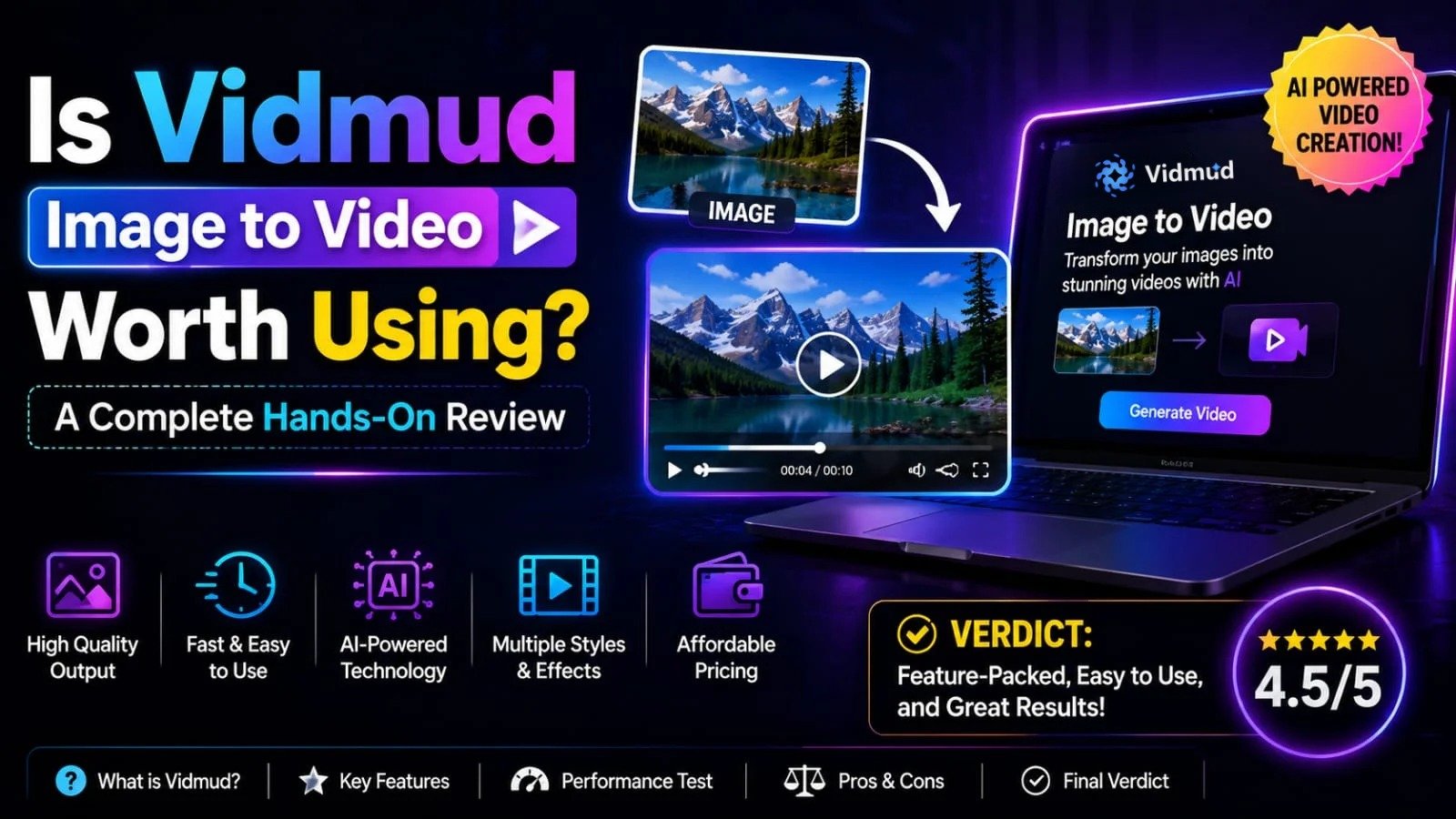
These AI tools that convert images into videos are extremely popular in 2026. Today, AI is enabling content creators, marketers, and photographers to convert static images into animated videos in just minutes. Users no longer need to spend hours tweaking their motion effects manually; they can upload an image and let the AI work its magic to create realistic movement.
In the landscape of increasingly powerful AI video generators, Vidmud Image to Video has begun to gain traction for its ease of use and usability. The platform aims to empower users to produce animated videos in a swift and trouble-free manner, without the need for advanced editing capabilities or costly software.
Vidmud seems to have the “fast, no frills, and privacy-focused” user in mind after having used the platform first-hand. The review will delve into the functionality, its advantages, and its viability for daily content production.
What is Vidmud Image to Video?
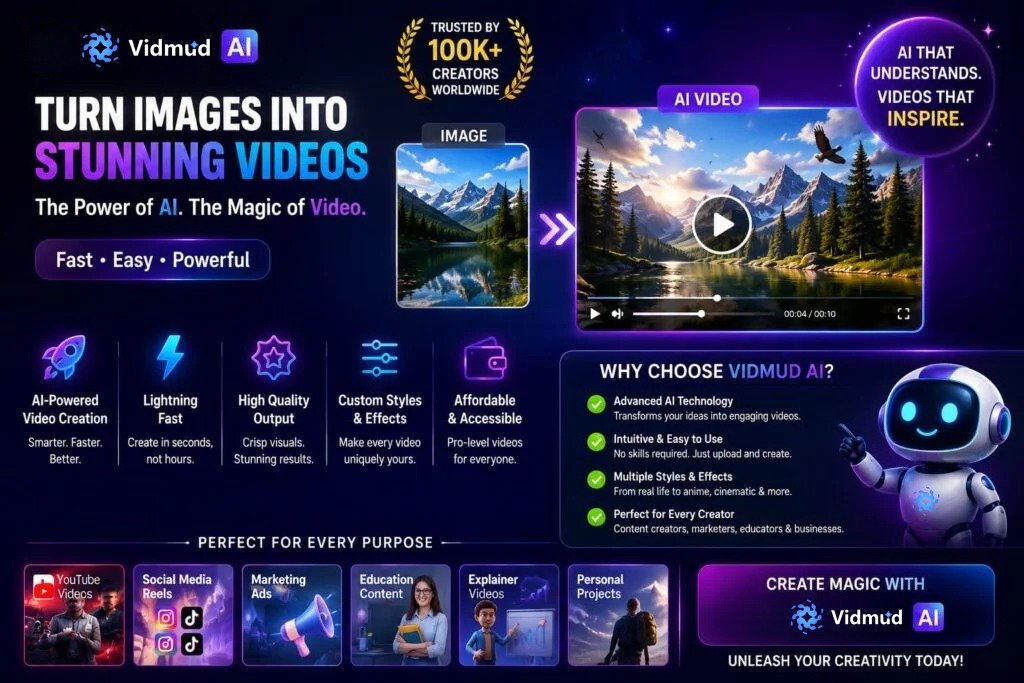
Vidmud Image to Video is a web-based AI tool that transforms images into videos. Users can upload portraits, product photos, landscapes, or any other image, and then select from a variety of AI-driven motion effects to produce dynamic and engaging videos.
Artificial intelligence models movement on the platform, including camera moves, facial expressions, animation of the environment, and cinematic transitions. According to Vidmud, the tool is easy to use and geared toward the rapid creation of web-based videos.
The process of editing movies is much simpler than conventional video editing software. Upload an image, add a description of the motion effect you want, and then the AI will create the video.
First Impressions and User Experience
The great thing about Vidmud Image to Video is its simple and easy-to-use interface. There are a lot of AI video tools that can be overwhelmingly complex or feature too many advanced options. Vidmud is easy to use even for novices, yet provides some customization features for advanced users.
Uploads are quick, and the drag-and-drop interface functions very well in the browser. The platform accepts common image formats like JPG, PNG, BMP, WebP, etc., ensuring that most users can access it.
The process of generating the AI itself is also relatively simple. The user can allow the AI to apply default motion effects or can provide text prompts to describe any kind of custom animation. This versatility adds to its creativity and usability.
Generally, the platform seems to be created for rapid content creation and not professional filmmaking. Social media clips, short animations, and experiments are surprisingly smooth.
No Signup Required Makes a Big Difference
One thing that’s great about Vidmud is the lack of a requirement for an account.
A large number of AI platforms require users to sign up, confirm emails, or provide payment information prior to accessing some basic functionality. Vidmud eliminates this friction. The image-to-video component of the platform can be used on the spot without registration.
This makes the workflow much quicker and more convenient, particularly if the user is casual and wants results quickly. The ability to test the platform without even signing up makes the entire thing user-friendly.
Many users find this convenience to be more compelling than some rivals, which are forced to use account systems and have barriers to entry.
Free Access Improves Accessibility
Also, Vidmud’s free approach is another reason why it’s becoming so popular.
The platform touts itself as an AI image-to-video creation platform, offering no hidden charges or subscription costs. This is crucial since many AI video generators can turn into a costly business, particularly for those who are not professionally making video content.
Vidmud seemed to be an ideal platform for dipping a toe into the water of AI animation, but not ready to sign up for premium services just yet. The platform’s open access increases its accessibility for students, newcomer creators, and even those new to AI-generated videos.
Privacy and Data Protection
A primary worry about AI-powered web tools is privacy and the uploading of personal photos. Vidmud takes privacy seriously, with this being the platform’s focus.
Uploaded files are said to be processed during the session and deleted as soon as they are generated. The company also says that images aren’t stored, shared, or used for AI training.
Because it is No Signup Required, No Data Saved, and Privacy Secured Processing, it engenders more trust than platforms that store uploaded media permanently.
These privacy-centric tools are particularly useful for those who use the platform for personal portraits, family photos, or private content.
Video Quality and AI Animation Results
The quality of the animation will be heavily reliant on the image uploaded. The results of motion are better when cleaner compositions, centered subjects, and higher resolution images are used. This aligns with the general feedback from the community regarding the workflow of creating videos from images using AI.
During testing, Vidmud was very good with simple animations like slight camera movements, facial movements, environmental effects, and cinematic zooms. The processed photos tended to look most natural as portraits or landscape photos.
Not all of the videos created with the program are flawless, particularly when used with high-resolution images or complicated visuals, but the results are still quite amazing given how easy it is to use the program. The AI is quite impressive when it comes to social media content, creative projects, or when it comes to the rapid creation of visual content for storytelling.
Final Verdict
Vidmud Image to Video stands out as a practical and user-friendly AI animation tool, prioritizing speed, simplicity, and privacy. While it can’t beat the powerful capabilities of professional video editing tools for more complex projects, it shines for creating rapid AI-generated animation videos and innovative online content.
The platform’s main advantages are definitely its ease of use and the respect for privacy it gives its users. The No Signup Required, Free access, No Data Saved, and Privacy Secured processing elements lend extra ease and trustworthiness to the tool compared to numerous rival AI generators.
Vidmud Image to Video is an excellent tool for those looking to create AI-animated videos in 2026 without requiring complex software or subscriptions.


Do Automatic Watches Need a Watch Winder? A Complete Guide for Collectors

Tattoo Culture as a Medium for Storytelling

The Art of Modern Lash Designs

Keala Winterhalt: Childhood, Career, and Family Roots

The Inspiring Story of Shea Joelle James in Hollywood

How Melanie Lynn Clapp Built a Creative Empire
-
 celebrity9 months ago
Keala Winterhalt: Childhood, Career, and Family Roots
-
 celebrity9 months ago
The Inspiring Story of Shea Joelle James in Hollywood
-
 celebrity9 months ago
How Melanie Lynn Clapp Built a Creative Empire
-

 celebrity9 months ago
Milo William Langdon: Life of Liv Tyler’s Youngest Son
-

 celebrity9 months ago
Jacelyn Reeves’ Life: Motherhood, Privacy, and Legacy in Hollywood
-

 celebrity9 months ago
Baxter Neal Helson Story: Marriage, Fatherhood, and Life Beyond the Spotlight
-

 celebrity9 months ago
Claudia Heffner Peltz Biography: Mother of Nicola Peltz and Family Matriarch
-

 celebrity10 months ago
How Wendy Etris and A.J. Styles Balance Family and Fame